

General information for participants
Arrival and registration
Arrival and registration
Registration and room allocation will take place at 16:00 in Undeloh (in front of the “Undeloher Hof”), where you also have the opportunity to park your car. After registration you should make your way to Wilsede, where you will be welcomed at the conference location. You will have time to meet the other participants and collect your name tags.
Information for presenters
Information for presenters
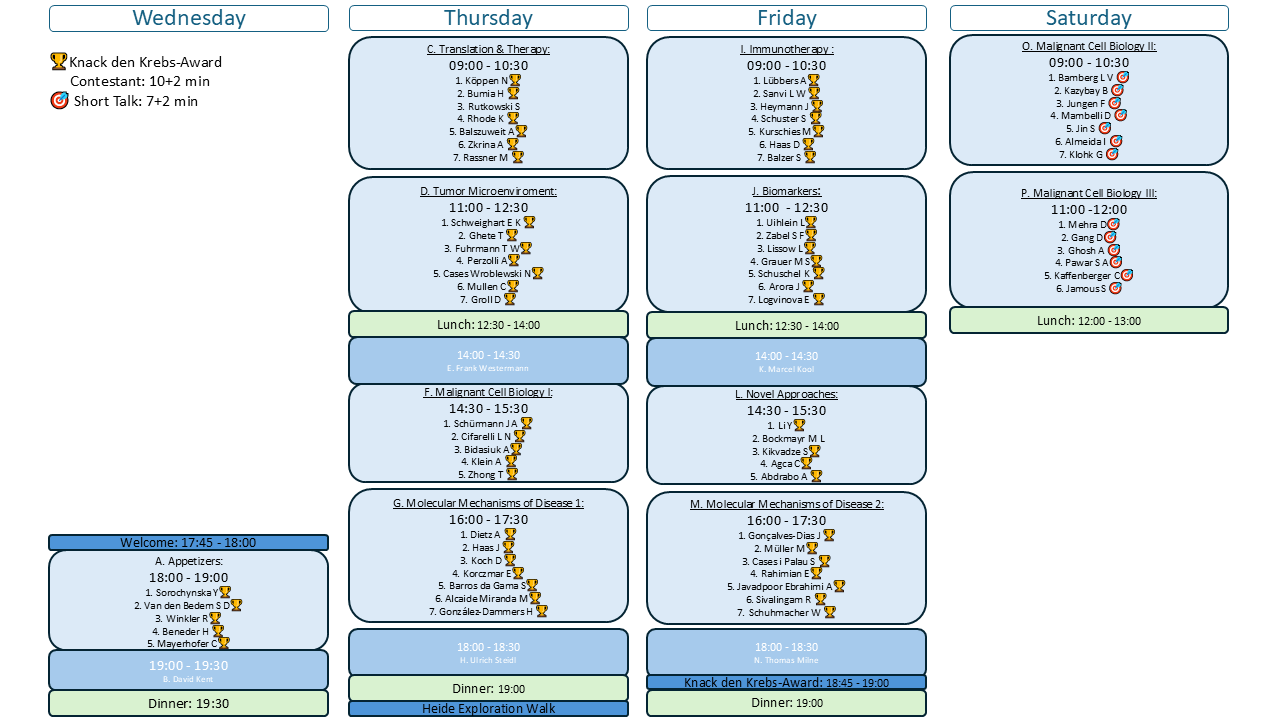
Presentations are 10 + 2 min (🏆) unless they are indicated as a short talk (🎯). Short talks are 7 + 2 min long. The exceptions will be our key note speakers for the invited lectures, who will be given 30 min time. Due to the large number of participants this year, we kindly ask you to stay within the time limit. We recommend to use a 16:9 formate for your presentation slides. Please also refer to the information you received via E-mail regarding the upload of your presentation. We have microsoft and IOS devices available for you to use to check and display your presentation from. Our friendly technical support will be located in the back of the conference room and available to assist you.
During your stay
During your stay
We advise you check the weather forecast, before you travel to Wilsede. The weather in July is usually fairly sunny and warm, so we recommend sun screen. However it might cool down in the evening and past events have also been accompanied by rain. We also note, that the roads/paths between Underloh and Wilsede are not paved and you may consider this when choosing footwear.
Shuttle service and horse carriage
At the day of arrival a shuttle service will be provided between 14:30-18:30 that will be departing from Handeloh train station to the registration in Undeloh. At the same day the first horse carriage rides will await you to take you from Undeloh to our conference location in Wilsede (last departure 16:45). From Thursday to Saturday horse carriages will also be available in the mornings (8:00) and evenings (23:00). The horse carriages will have two stops in Undeloh „Heiderose“ and „Undeloher Hof“, and one stop in Wilsede at the conference centre. At the end of the conference horse carriages will bring the guests a last time from Wilsede to Undeloh, from where shuttle services will be available from 11:30-14:30 to allow transfer between Undeloh and Handeloh Bahnhof.
If you travel outside of the shuttle service times, public transport (Bus line 4000) is available between Undeloh (Osterdiecksfeld) and Handeloh train station. Find the next bus at: HVV Fahrplanauskunft.
WEDNESDAY, June 3, 2026
16:00 – 17:30
16:00 – 17:30
Arrival and registration
Registration
17:30 – 17:45
17:30-18:00
Opening speech
Welcome speech
by Rolf Marschalek & Jan-Henning Klusmann
17:45 – 19:00
18:00 – 19:00
(A) Appetizers
(A) Appetizers
Chair: Owen Williams
A1. Analyzing Differentiation Patterns in Sonic Hedgehog-Activated Medulloblastoma 
Sorochynska Y; Hamburg
A2. Development of a High-Throughput Drug Screening Platform for Patient-Derived AML using Machine Learning Image Analysis.
van den Bedem S D; Utrecht
A3. An Integrated Epigenomic Atlas Defines Master Transcription Factor Circuits in Pediatric AML
Winkler R; Frankfurt
A4. Domain scanning reveals essential protein-protein interfaces within the SAGA complex in AML
Beneder H; Frankfurt am Main
A5. OGFOD1 enables AML chemo- and nutrient stress resistance by regulating protein synthesis
Mayerhofer C; Freiburg
19:00 – 19:30

19:00 – 19:30
(B) Invited Lecture I
(B) Invited lecture I
Chair: Jan-Henning Klusmann
New tools to study clonal evolution in blood stem cells
David Kent
University of York, United Kingdom
19:30
19:30
Dinner
Dinner
THURSDAY, June 4, 2026
09:00 – 10:30
09:00 – 10:30
(C) Translation and therapy I
(C) Translation & Therapy
Chair: Lennart Lenk
C1. The PARP inhibitor pamiparib effectively radiosensitizes medulloblastoma while sparing healthy brain tissue
Köppen N; Hamburg
C2. Identifying Drug Resistance Pathways in Paediatric Acute Myeloid Leukaemia
Bumia H; London
C3. Treatment de-intensification for WNT medulloblastoma: Results from the favourable-risk arm of the SIOP-PNET5-MB study
Rutkowski S; Hamburg
C4. Single-cell tracing identifies a stage-spanning progenitor linked to chemoresistance in Down syndrome myeloid leukemia
Rohde K; Frankfurt
C5. Prediction of Anthracycline Toxicity in Childhood Cancer: Linking Germline DNA Damage Response Variants to Drug Response
Balszuweit A; Munich
C6. Ex vivo drug response profiling reveals conserved therapeutic vulnerabilities across organ compartments in ALL s
Zkrina A; Ulm
C7. Molecular targeting of aberrant tumor transcriptomes
Rassner M; Frankfurt am Main
10:30 – 11:00
10:30 – 11:00
Coffee break
Coffee break
11:00 – 12:30
11:00 – 12:30
(D) Signal transduction
(D) Tumor Microenviroment
Chair: Davide Serrugia
D1. Single-Cell Profiling Unveils Multilineage Fusion Persistence and Microenvironmental Priming in pAML Relapse
Schweighart E K; Utrecht
D2. The landscape of germline variants in children with chronic myeloid leukemia
Ghete T; Erlangen
D3. Asciminib supports skeletal safety in CML: reduced osteoclast demineralization without disrupting differentiation
Fuhrmann T W; Erlangen
D4. Pediatric AML blasts induce immunosuppressive reprogramming in macrophages via nanotube mitochondrial transfer
Perzolli A; Utrecht
D5. The Role of Tumor Associated-Macrophages in Medulloblastoma? – Histopathological Insights
Cases Wroblewski N; Hamburg
D6. Blast-Driven Immunosuppression Defines the Immune Landscape in Infant KMT2A::MLLT3 Driven Acute Myeloid Leukaemia
Mullen C; Edinburgh
D7. Investigating the microenvironment in the hematopoietic niche
Groll D; Frankfurt am Main
12:30 – 14:00
12:30 – 14:00
Lunch (Wilsede, Heidemuseum)
Lunch (Wilsede, Heidemuseum)
14:00 – 14:30
14:00 – 14:30

(E) Invited Lecture II
(E) Invited Lecture II
Chair: Martin Stanulla
Onset and evolutio of embryonal tumors
Frank Westermann
German Cancer Research Center (DKFZ), Germany
14:30 – 15:30
(F) Tumor Microenvironment
14:30 – 15:30
(F) Malignant Cell Biology I
Chair: Hannah Uckelmann
F1. Clinical, histological and molecular characterization of MYCN-like spinal ependymoma
Schürmann J A; Hamburg
F2. Beyond TP53 mutation: transcriptional regulation of the p53 pathway in pediatric AML
Cifarelli L N; Frankfurt am Main
F3. Integrative multiomics profiling of an anaplastic juvenile granulosa cell tumour: a case study of an ultra-rare entity
Bidasiuk A; Hamburg
F4. CAP1 deficiency impairs development of cerebellar granule neurons and prolongs survival of SHH medulloblastoma in mice
Klein A; Hamburg
F5. Identification of novel candidates for targeted therapy in leukemia
Zhong T; Frankfurt am Main
15:30 – 16:00
15:30 – 16:00
Coffee break
Coffee break
16:00 – 17:30
16:00 – 17:30
(G) Molecular mechanisms of disease I
(G) Molecular Mechanisms of Disease I
Chair: Roland Kappler
G1. The missing link for growing leukemia patient cells ex vivo
Dietz A; Frankfurt am Main
G2. An Optimized Cas13d Scaffold for Multi-Target RNA Knockdown Enables Combinatorial Screening in FLT3-Mutant AML
Haas J; Frankfurt am Main
G3. Metabolomic profiling identifies targetable metabolic dependencies in pediatric acute myeloid leukemia
Koch D; Frankfurt am Main
G4. From Fusion to Function: Investigating the Mechanisms of ZNF384 Fusion Oncoproteins in B-ALL
Korczmar E; Vienna
G5. Wildtype NUP98 Cooperates with Mutant NPM1 to Drive Oncogenic Transcription
Barros da Gama S; Frankfurt am Main
G6. Investigating somatic events and epigenetic signatures in GATA2 deficiency to predict and prevent BMF and leukemia
Alcaide Miranda M; Ulm
G7. Investigating the chromatin functions of Exportin-1 (XPO1) in NPM1c-driven acute myeloid leukemia
González-Dammers H; Frankfurt am Main
18:00 – 18:30
(H) Invited Lecture III
18:00 – 18:30
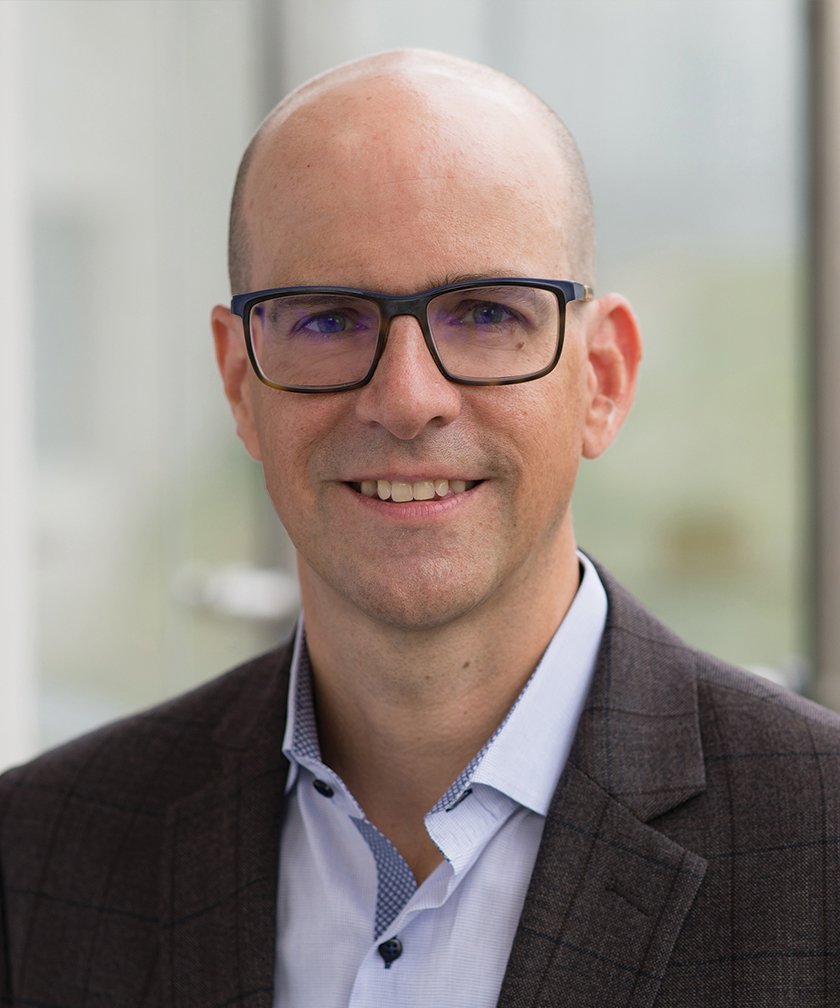
(H) Invited lecture III
Chair: Olaf Heidenreich
Heparan sulfate glycotypes are determinantes of stem cell heterogeneity and function
Ulrich Steidl
Albert Einstein College of Medicine in New York, USA
19:00
19:00
Dinner
Barbecue
FRIDAY, June 5, 2026
09:00 – 10:30
09:00 – 10:30
(I) Immunotherapy
(I) Immunotherapy I
Chair: Katrin Ottersbach
I1. Novel Cytokine Protocols Enhance CIK Cell Efficacy and Polyfunctionality in High-Risk Pediatric Malignancies
Lübbers A; Frankfurt am Main
I2. Development of a New Immunotherapy Treatment Based on Gene-Modified Adaptive NK Cells for the Refractory Lymphomas
Sanvi L W; Würzburg
I3. HER2-directed immunotherapy shows preclinical activity in acute lymphoblastic leukemia
Heymann J; Kiel
I4. Development of novel CAR Cell Therapeutics in Pediatric AML
Schuster S; Frankfurt am Main
I5. Enhancing CD127-targeted immunotherapy in ABL-class fusion+ B-ALL through combination with next-generation TKIs
Kurschies M; Kiel
I6. Dual CAR-TCR and CD8 Engineering Improves Adoptive T-Cell Therapy Beyond MHC I Limitations
Haas D; Würzburg
I7. Daratumumab Efficacy Is Affected by Macrophage Fratricide and Polarization in T-ALL
Balzer S; Dresden
10:30 – 11:00
10:30 – 11:00
Coffee break
Coffee break
11:00 – 12:30
11:00 – 12:30
(J) Biomarkers
(J) Biomarkers
Chair: Denis Schewe
J1. Deciphering the function of circular RNAs in Therapy Resistance of Relapsed Pediatric Acute Lymphoblastic Leukemia
Uihlein L; Berlin
J2. Genome-wide cfDNA Profiling from Whole Blood Reveals Molecular Risk and Potential for Early Detection in Neuroblastoma
Zabel S F; Heidelberg
J3. Molecular characterization of hybrid neurofibroma schwannomas (HNS) in patients with tumor predisposition syndromes
Lissow L; Hamburg
J4. Prospective evaluation of molecular markers in non-high-risk neuroblastoma patients
Grauer M S; Cologne
J5. Unveiling the Molecular Complexity of AML through Advanced Multi-Omics Analysis
Schuschel L; Frankfurt am Main
J6. Decoding intratumoral heterogeneity and tumor evolution of malignant peripheral nerve sheath tumors.
Arora J; Hamburg
J7. CRISPRi Screening in an ALL/Macrophage Co-Culture System to Identify Targets for Optimizing Antibody-Mediated Responses
Logvinova E; Dresden
12:30 – 14:00
12:30 – 14:00
Lunch (Wilsede, Heidemuseum)
Lunch (Wilsede, Heidemuseum)
14:00 – 14:30
14:00 – 14:30

(K) Invited Lecture
(K) Invited Letcure IV
Chair: Martin Stanulla
Pros, cons, and gaps of preclinical models for brain tumors
Marcel Kool
KiTZ Heidelberg, Germany, and Princess Máxima Center Utrecht, the Netherlands
14:30 – 15:30
14:30 – 15:30
(L) Tumor microenviroment
(L) Novel Approaches
Chair: Dirk Heckl
L1. Development of 3D Ex Vivo Acute Myeloid Leukemia (AML) Niche Models Using iPSC
Li Y; Utrecht
L2. Outlier-exposed neural networks for robust DNA methylation-based molecular diagnostics
Bockmayr M L; Hamburg
L3. Human Induced Pluripotent Stem Cell-Derived Macrophages as a Model to Evaluate Antibody-Based Therapies in ALL
Kikvadze S; Dresden
L4. Machine learning identifies flow cytrometric predictors of progression in transient abnormal myelopoeisis
Agca C; Frankfurt am Main
L5. Fine-mapping interactions of the N-terminal domain of GATA1 during leukemogenesis 🏆
Abdrabo A, Frankfurt am Main
15:30 – 16:00
15:30 – 16:00
Coffee break
Coffee break
16:00 – 17:30
(M) Molecular mechanisms of disease II
Chair: David Ghasemi
M1. A comprehensive long-read isoform-resolved transcriptome reference maps alternative splicing diversity in pediatric AML
Gonçalves-Dias J ; Frankfurt am Main
M2. Investigating the role of Nuclear Pore Proteins in NPM1 mutant leukemias
Müller M; Frankfurt am Main
M3. Deciphering the role of KANSL1 mutations in the development of Myeloid Leukemia in children with Down Syndrome
Cases i Palau S; Frankfurt am Main
M3. CRISPRi screening identifies PPCDC as a selective metabolic dependency with therapeutic potential in AML
Rahimian E; Dresden
M4. Wildtype NUP98 Cooperates with Mutant NPM1 to Drive Oncogenic Transcription
Barros da Gama; Frankfurt am Main
M5. Epigenetic Drug Screening Identifies a Selective Vulnerability for NPM1c-driven Leukemia
Javadpoor Ebrahimi A; Frankfurt am Main
M6. Identification of RNA-binding proteins that control critical KMT2A-MLLT3 mRNA levels in acute myeloid leukemia
Sivalingam R; Basel
M7. Investigation of Initial Tumor Proliferation in Stage 4S Neuroblastoma
Schuhmacher W; Cologne
16:00 – 17:30
(M) Molecular Mechanisms of Disease II
17:30 – 18:00
Coffee break
17:30 – 18:00
Coffee break
18:00 – 18:30
18:00 – 18:30

(N) Invited Lecture V
(N) Invited lecture
Chair: Rolf Marschalek
Epigenetic Regulation of Gene Expression in Hematopoiesis and
High RiskPediatric Leukemia to Enable Rational Therapeutic Targeting
Thomas Milne
Oxford University, United Kingdom
18:30 – 18:45
18:30 – 18:45
Wilsede award
Knack den Krebs-Award
presented by Jan-Henning Klusmann
19:00
Dinner
19:00
Dinner
SATURDAY, June 6, 2026
09:00 – 10:15
09:00 – 10:30
(O) Short talks I
(O) Malignant Cell Biology
Chair: Mark Hartmann
O1. BH3-mimetics to overcome radioresistance in pediatric ependymoma 
Bamberg L V; Heidelberg
O2. Adipogenic priming of mesenchymal stroma is a prominent feature of the iAMP21 ALL bone marrow microenvironment
Kazybay B; Utrecht
O3. Deep Saturation Mutagenesis Screen of CD19 Extracellular Domain to Identify Mutations Conferring Blinatumomab Resistance
Jungen F; Vienna
O4. Effects of RUNX1::RUNX1T1 Depletion on Leukemic–Immune Cell Interactions
Mambelli D; Utrecht
O5. Characterization of murine stem and progenitor cells harboring oncogenic PTPN11 or KRAS mutations
Jin S; Ulm
O6. TRIM21-Based Molecular Glue Degraders as a Strategy to Target NPM1 mutant AML
Almeida I; Frankfurt am Main
O7. Molecular and immunohistochemical comparison of primary and recurrent malignant peripheral nerve sheath tumours
Klohk G; Hamburg
10:15 – 10:45
10:30 – 11:00
Coffee break
Coffee break
10:45 – 12:00
11:00 – 12:00
(P) Short talks II
(P) Malignant Cell Biology III
Chair: Christian Braun
P1. PDX models from diagnosis-relapse pairs of pediatric T-cell acute lymphoblastic leukemia (T-ALL)
Mehra D; Heidelberg
P2. RUNX1/ETO Suppression Induces a CD15+ AML State Linking Lineage Plasticity to Immune Remodeling
Gang D; Utrecht
P3. Investigating the epigenetic landscape changes accompanying the shift from healthy to malignant hematopoiesis
Ghosh A; Frankfurt am Main
P4. LIMS1 is a new therapeutic target for acute myeloid leukemia
Pawar S A; Munich
P5. CRISPR-Cas-based optimization of NK- and CIK-cell immunotherapy in pediatric acute myeloid leukemia
Kaffenberger C; Frankfurt am Main
P6. Identifying Synergistic Combination Strategies for Neuroblastoma Using CRISPR Functional Genomics
Jamous S; Frankfurt am Main
12:00 – 13:00
12:00 – 13:00
Lunch
Lunch (Wilsede, Heidemuseum)
13:00
13:00
Departure
Departure
Many thanks for making this meeting possible:





Many thanks for making this meeting possible:


